 Playcard games
Red dog rules
Bet on whether the third card falls between the first two.
- 2-6 players
- Standard deck
Also called acey-deucey or in-between. You bet on whether a third card lands between the first two.
The table
Up to six players bet against the house, all on the same two cards. Casinos deal from several decks; a home game uses one.
The deal
Place a bet. Two cards are turned face up. Aces are high, and only the ranks matter.
The spread
Count the ranks strictly between the two cards. That number is the spread.
Consecutive cards, spread zero: the hand is a push and the bet comes back. Equal cards: a third card is dealt at once. Match it and you are paid heavily; otherwise the hand is a push. Anything else: the spread is announced and play continues.
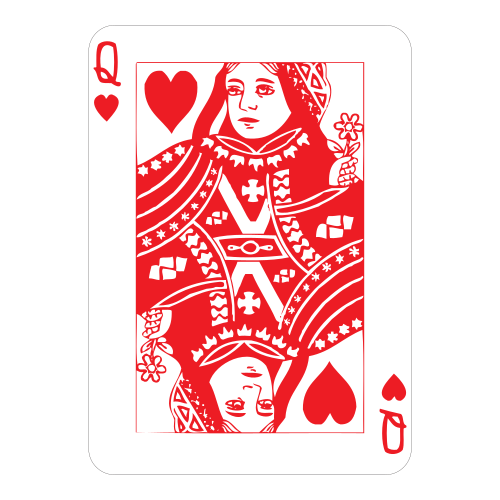
A four and a jack have six ranks between them — five, six, seven, eight, nine and ten — so the spread is six.
Raising
Before the third card you may double your bet. Do it on a wide spread and not on a narrow one — with a spread of one the odds are firmly against you.
The third card
It is turned face up. Strictly between the two, and you win. Equal to either of them, or outside, and you lose.
Payouts rise as the spread narrows: even money on a wide spread, and up to five to one when the spread is a single rank.
The pay table
A common table pays: Spread of one: five to one. Spread of two: four to one. Spread of three: two to one. Spread of four or more: even money. A pair matched by the third card: eleven to one.
The odds
Every rank in the spread has four cards in a single deck, so a spread of one gives four winning cards out of about fifty. A spread of seven gives twenty-eight, better than half. That is why the usual advice is to double on a spread of seven or more and never below it.
Found a mistake, or something unclear, in these rules? Tell us